Teach Idioms Using the Dictionary
Applicable Grades: 9 -12, also useful for B.Ed. Level Major English.
Objectives: On completion of this lesson, the students will be enabled to:
• Find the idioms in the Oxford Advanced Learners Dictionary(OALD)
• Use idioms in their day to day life
• Synthesize their knowledge of idioms by presenting the figurative interpretation of idioms.
Warm up: Brainstorm the students by writing a Nepali idiom “ dandamathiko joon” and ask them to give the meaning of it and use it in a sentence.
Teaching learning activities: Ask the students: On the basis of the Nepali idiom, can you give the meaning of an idiom?
Elicit answers from them and if they cannot figure out the meaning, explain to them the following points.
• An idiom is a group of words whose meaning cannot be deduced form the individual words used in it and should be learnt as a whole.
• The word ‘idiom’ originates from a Latin word ‘idioma’ meaning ‘special property.
• An idiom conveys a figurative meaning rather than a literal meaning.
• An estimated number of 25,000 idioms are presumed have existed in the English language.
• They have their special entity in any language.
• Native English speakers use a number of idiomatic expressions in their daily life, which may cause problems to a non-native English speaker.
• Idioms add to the beauty of English and play an effective role in getting our message across.
• Idioms are culture specific rather than language specific.
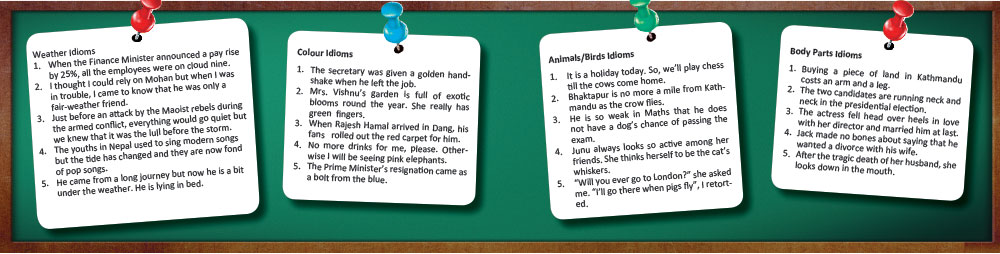
Divide the students into 4 groups and distribute them the posters with 5 sentences each on which the idioms are underlined. In order to facilitate better understanding, the idioms can be categorized into weather idioms, colour idioms, animal/bird idioms and body part idioms.
Weather Idioms (group A)
1. When the Finance Minister announced a pay rise by 25%, all the employees were on cloud nine.
2. I thought I could rely on Mohan but when I was in trouble, I came to know that he was only a fair-weather friend.
3. Just before an attack by the Maoist rebels during the armed conflict, everything would go quiet but we knew that it was the lull before the storm.
4. The youths in Nepal used to sing modern songs but the tide has turned and they are now fond of pop songs.
5. He came from a long journey but he is a bit under the weather. He is lying in bed.
Colour Idioms (Group B)
6. The secretary was given a golden handshake when he left the job.
7. Mrs. Vishnu KC’s garden is full of exotic blooms round the year. She really has green fingers.
8. When Rajesh Hamal arrived in Dang, his fans rolled out the red carpet for him.
9. No more drinks for me, please. Otherwise I will be seeing pink elephants.
10. The Prime Minister’s resignation came as a bolt from the blue.
Animals/Birds Idioms( Group C)
11. It is a holiday today. So, we’ll play chess till the cows come home.
12. Bhaktapur is no more a mile from Kathmandu as the crow flies.
13. He is so weak in Maths that he does not have a dog’s chance of passing the exam.
14. Junu always looks so active among her friends. She thinks herself to be the cat’s whiskers.
15. “Will you ever go to London?” she asked me. “I’ll go there when pigs fly”, I retorted.
Body Parts Idioms
16. Buying a piece of land in Kathmandu costs an arm and a leg.
17. The two candidates are running neck and neck in the presidential election.
18. The actress fell head over heels in love with her director and married him at last.
19. Jack made no bones about saying that he wanted a divorce with his wife.
20. After the tragic death of her husband, she looks down in the mouth.
Ask the groups to deduce the meaning of the idioms written in italics from the context in which the sentences are written.
The students try to guess the meaning of the idioms and write them in their notebooks.
Students read the sentences to the whole class and try to deduce the meaning collectively.
Distribute Oxford Dictionaries to each of the groups to find out the meaning of the given idioms.
Say that the meaning of an idiom should be looked up from the head entry. For instance, in order to find the meaning of under the weather, we should look up the entry ‘weather’. There may be cross references under which entry an idiom can be found.
Ask the students work with the meanings and move around the class and provide help in case they are struggling or in confusion.
When students have finished, write the idioms with their meanings on the board.
Weather idioms
1. on cloud nine = extremely happy and excited.
2. fair-weather friend = somebody who stops being a friend when you are in trouble.
3. the lull before the storm = a quiet period before a violent activity.
4. the tide has turned = a trend has changed from one thing another.
5. under the weather = not feeling well.
Colour idioms
6. golden handshake = a large sum of money that is given to someone when they leave their job
7. green fingers = good at growing plants
8. roll out the red carpet = to honour somebody or treat somebody in a special manner
9. pink elephants = hallucinations or strange imaginary things seen by a drunkard as a result of intoxication
10. a bolt from the blue= sudden and unexpected.
Animal/ bird idioms
11. till the cows come home = for a long time
12. as the crow flies = in a straight line
13. not have a dog’s chance = to have no chance at all
14. the cat’s whiskers = to be a best person
15. when pigs fly = never
Body parts idioms
16. cost an arm and a leg = very expensive
17. neck and neck with somebody = go parallel in a competition.
18. head over heels in love = madly in love
19. made no bones about saying = not hesitate to say
20. down in the mouth = unhappy and depressed
Evaluation
Speaking in pairs
Display all the four posters on the board and have the students to have a short conversation using the idioms just practised.
Homework
Find the following idioms in the dictionary and use them in a meaningful sentence.
i. a lame duck
ii. alive and kicking
iii. spill the beans
iv. hold your horses
v. full steam ahead
(The auther teaches English at Shree Higher Secondary School, Rajhena Dang.)